Recovering from the last week of this adventure took as much time as living it. The numbers outline the events: 189 wines in three days of technical tasting, jostling with 153,000 industry professionals, followed by a painful passage at 35,000 feet.
I stepped off the train with suitcase, briefcase and mandolin in Desanzano del Garda, one of the charming lakeside resort towns west of Verona. Air temperature was in the 70’s with a breeze sweeping off the lake, freshening the long shadows of afternoon. I met with my friend Chris Zimmerman, Northwest Regional Sales Manager for Vias Imports Ltd., which represents many of Italy’s finest family-run wineries, and which accounts for 90% of bottles on Tappi’s list. I was joining Chris and Vias’ U.S. sales team for three days at Vinitaly, the largest exhibition of wine in the world, where more than 4,000 producers host elaborate and elegant tasting booths to demonstrate their work. In the next 72 hours we would taste:
Cantele, 7 wines
La Lestra, 4
Produttori del Barbaresco, 5
Pecchenino, 8
Ca’ Viola, 7
Araldica, 6
Pietra Porzia, 3
Damilano, 12
Marenco, 6
Terradora, 11
Torre di Luna, 11
Statti, 4
Broglia, 3
Bisol, 6
Rocca di Franscinello, 5
Saiagricola, 5
Castello di Luzzano, 6
Elvio Cogno, 9
Nureghe Crabioni, 4
Feudo di Santa Tresa, 6
Colosi, 4
Ceuso, 4
Suavia, 5
Vie di Romans, 10
Tenuta Luisa, 7
Camigliano, 4
Istituto Agrario di San Michele All’Adige, 13
Maso Poli, 4
San Leonardo, 8
Standouts for me were the Cantele Brothers’ Chardonnay ’10, Negro Amaro Rosato ’10, Primitivo and Amativo, both ’08; Produttori Del Barbaresco’s Torre ’07 & ’08; Orlando Pecchenino’s Siri di Jermu Dolcetto ’08 and the La Coste Barolo ’07; Araldica’s Rapido Pinot Grigio and Sangiovese, ’10; Damilano’s Barbera d’Asti ’09; Terradora’s Falanghina and Greco di Tufo, ’10, and their Taurasi ’04 (Barolo of the south); Broglia Gavi Meirana ’10; Bisol Cartizze; Giovannella Fuggazza’s Castello di Luzzano Seta, Magot, Bonarda Frizzante, Carlino and Romeo; Valter Fissore’s Elvio Cogno Dolcetto d’Alba ’10, Montegrilli ’09 & Cascina Nuova Barolo ’06; Feudo di Santa Tresa organic biodynamic Purato Nero d’Avola; and Istituto di San Michele’s entire lineup.
----
Once in a great while I taste a wine that transcends all previous experience. On the plains of northeast Italy, against the backdrop of the Julian Alps of Slovenia, I had such an encounter: white wines that are every bit as complex, as beautiful and elegant and delicious as the most sophisticated and elevated red I’ve ever had — the varietals produced by Gianfranco Gallo at the winery Vie di Romans, in Mariano del Friuli.
On more than a hundred acres of family ground, Gallo has been building his winery since 1978. He is a sophisticated student of geology and climate, as all serious estate winemakers must be. His 50 hectare property spans four DOCs in the Isonzo region, long known for its production of whites. The farm cultivates Sauvignon, Chardonnay, Rhein Riesling, Gewürtzraminer, Pinot Grigio, Malvasia Istriana, Friulano, and a small crop of Merlot, bottling 12 labels in all. The vineyards stand between the Mediterranean climate, which produces fatter, structured ripe fruit, and the Continental climate, which accounts for minerality and acidity. Caught between the drying cold winds from northern glacial fields and the warm moist breezes up from the Adriatic, the farm experiences the high temperature differentials day to night that contribute to the wines’ complexity and long lives.
Gianfranco doesn’t release his wines until they are two years old, a rare and dramatic statement in itself since most whites are most prudently consumed within two years of production. And even more impressive, he measures expected cellar life for his wines up to 20 years, with most bottles capable of more than 15 years in the cellar.
Interestingly, at the edges of the republic — Friuli and Sargedgna — at least two other producers are extracting ever-more complexity from whites: Alessandro Dettori’s Vermentino di Sardegna and Josko Gravner’s Ribolla Gialla and Breg. In fact, these three producers have been responsible for three of the most powerful wine drinking experiences I’ve had; wines so complex, so profoundly nuanced and so radically different from all the whites commonly tasted that, I’m willing to bet, if they were served at cellar temperature and poured blind to you while you yourself were wearing a blindfold, they would stand up powerfully to the noblest dolcettos, barbarescos, and even barolos.
In the cantina on the day of harvest, Gianfranco precipitously drops the fruits’ temperature from 28C on the skins to 5C in airless tanks. With the oxygen removed, the fruits’ aromatics and colors are fixed. His pinot grigio, labeled Dessimis, is a rich coppery rose, the startling result of preserving the grape’s true characteristics. Taste this wine and you might agree with my friend Chris: this is the best Pinot Grigio he’s ever tasted.
Vie di Romans wines will be available at Tappi for summer. Preliminary estimates suggest a cost at the table of around $65. For guests who truly appreciate artistry in wine, a bottle of Vie di Romans will be a very satisfying experience.
---
Nightmare at 35,000 feet
I started the morning at 4:30 with a coffee at the hotel kitchen with the night clerk. Rain fell steadily through windswept darkness, and the taxi ride to the airport gave me a chill. The Verona terminal is small, with less than ten gates in one well-lit building. Even at that early hour, the interior felt like the town square with people milling about, chatting over coffees like old friends, happy to be together at that hour with wind and rain outside.
After I passed through security, I found a quiet corner in an empty section of airport seats, snapped open the case and played softly; it’s a solitary practice with a sound track, a conversation with my old friend the mandolin. The mild discomfort at the base of my sternum seemed like slight indigestion, probably from the thick espresso less than an hour before.
The discomfort grew. I put away my mandolin and walked around the terminal, with a feeling of pressure building steadily below my ribs. Within thirty minutes it was subsiding; I chalked it up to coffee and travel jitters.
Two hours later, running for my gate at Charles De Gaulle for the long final flight back to Seattle, my mind was wrapped up in not missing the plane. I was one of the last passengers to board.
My briefcase and mandolin and coat stowed above, I settled into my seat, suddenly hungry. As soon as we gained altitude, lunch arrived and I ate every bite. The flight was full, and the attendants aboard Air France 306 were pleasant and busy. I found a pillow and a blanket, turned my watch back nine hours, reclined my seat and closed my eyes. Then I felt it again, the unpleasant pressure below my ribs. I stood up and walked the aisle. Didn’t help. Got worse. Less than thirty minutes later, I was hiding in the tail around the aft galley. The flight attendants, bless their hearts, eyed me with concern as they went about their work. I was perspiring. One of the crew, the attendant in my seat section, looked into my eyes and asked if I was okay. I smiled weakly. She waited. I shook my head.
We tried antacids from the first aid kit. I sat down in a crew jump seat. I tried walking again. I leaned against the bulkhead, and groaned. I doubled up, and slid to the floor. They called for a doctor.
Three people showed up: Mark, a psychiatrist, Tobias, an emergency room nurse, and Robert, a Marine medic. I was on my back, doubled up with pain. I passed out. I wanted to pass out.
For two or three hours I was on the floor of the aft galley, an I.V. bringing fluid and morphine into my right arm, as a solitary gall stone shouldered its way through a tight biliary tract to the top of my small intestine. I spent the next five days, sleeping, my sister Angela’s house in Seattle. Now, after blood tests, ultrasounds and CT scans, I am back at work feeling 100% better, stoking the pizza oven four nights a week, pouring wine and watching the rain.
I hope to see you soon.
Saturday, May 14, 2011

Tuesday, April 5, 2011
An evening in Maremma
The men loaded into the Land Rover to cover maybe ten kilometers of heavily rutted double track, the red clay of Tuscany, heaved by months of freeze, porous and ruptured, then grooved by the first venturing jeeps of spring. The Rover’s heavy suspension came alive as Marco powered us over the broken ground, following the deep tracks of vehicles that must have wallowed and high-whined through greasy clay, farmers revving among these remote emerald pastures, their mud boots splattered and drying on the floorboards of trucks and tractors pushing through winter’s waning wet hold on the ground. These were the back roads.
Marco had straightened up, leaned in to the conversation the night before when he heard the bits and pieces of table conversation that revealed my passion for country side and its wild boarders. So plans were made to eat at Fontanile Dei Caprai, a rustic eatery in this remote pastoral landscape of the lower Maremma, and four of us were headed there now, the back way: Marco, Paolo, Jacopo and me. Bouncing along, Marco and I laughed when we discovered that I’m five days older than he is. From the back seat, I rested my hands on his shoulders, feeling close to him.
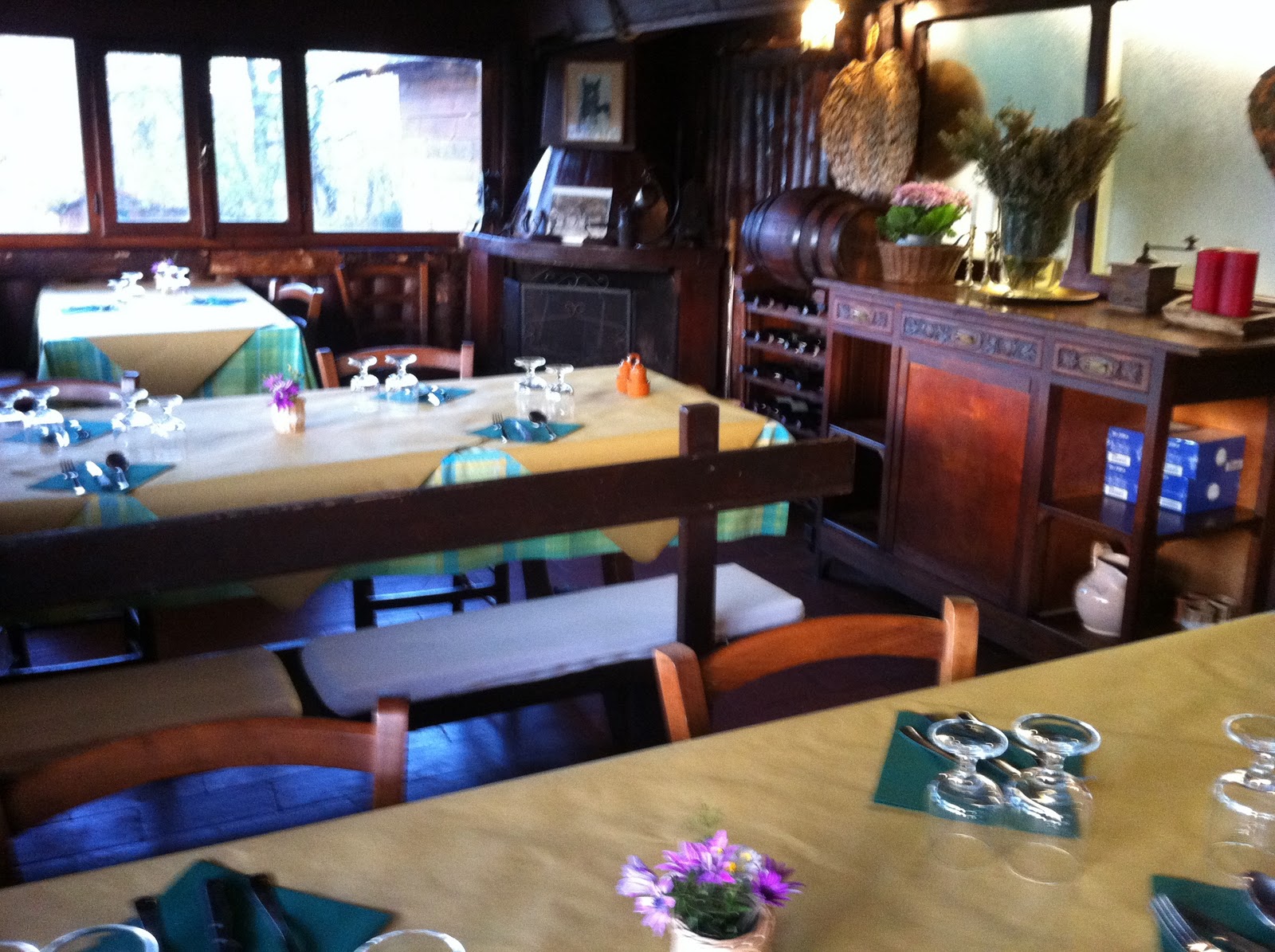
We drove along a small herd of Maremmana, the dapple-grey long-horn beeves native here in the marshy coastal region of lower Tuscany. They watched us as we passed out of that back country and came in sight of a paved road and the osteria. Low slung roof, hand-cut and hewn post and beam, it looked like a loafing shed from long ago that had been cleaned out and straightened up, its walls framed mostly with glass to look out at the green swells of pasture, the wood framed doorway varnished dark, warm yellow light coming from inside. The proprietress was a heavy-shouldered older woman, handsome in country ways, with her slim young daughter and a stout older girl in an apron watching from the kitchen. Vera, Marco’s wife, met us there.
The specialty of the house is cingale, wild boar, slow cooked with tomatoes and wine in a dutch oven near wood flame, with boiled potatoes and rosemary. We ordered it, and roasted pork and roasted rosemary chicken.
Before the cingale, we picked from a platter of sliced salami, capocola and a smoked sausage, and olives. Sitting outside under the low shed roof, we drank wine and ate meat and olives and last fall’s olive oil with crusty bread, and watched night pour over the contours of field and forest’s edge. A strange bird whoooed; Vera thought it the assiolo, a small owl of pine forests. There were islands of easy conversation, surrounded by the quiet of sitting together and watching the night come to us.
We tasted two versions of morellino, the west-country name for sangiovese: one, bottled and labeled by a new winery next door to the restaurant, it’s buildings so freshly planted and awkward on the landscape that the locals regarded it as a poor intrusion. The other wine came to table in a small glass carafe, the product of much less elaborate efforts down the road. The more rustic wine, lighter in color and perfume, had the delicate touch of bruised rose petals on my tongue, and tasted more of open air fermentation, the dark juice lightened by airborne yeasts and the soft atmosphere of wild herbs. The bottled wine offered a more conventional expression of sangiovese, closed and confined, with the familiar roundness of wood. I prefered the homemade, the difference between a florist’s expensive arrangement and a bouquet of wild flowers.
Before the cingale arrived at table on this night in early spring, we ate a soup of farro, lentils, carrots and celery. Thick, creamy with the starch of long-cooked grain — molto saporoso — rich-flavored. We drizzled it with a thin stream of green olive oil and thickened it with bread scraps. Nobody spoke, just the spoons tapping against the dark ceramic bowls.
The boar was delicious: the result of long slow cooking of wild meat, the strings of sinew softened and saturated with tomatoes, wild herbs and wine. More bread to clean our plates before tasting the fat-rich pork roast and glistening chicken.
Dinner ended with vin santo, the lighter northern Italian version of amber dessert wine (at Tappi we serve malvasia, a heavier golden raisin wine native to Sicily) and cannucci, the low-profile almond biscotti that’s been married to vin santo for centuries. Dip the cookie in the wine, stir it up, and enjoy the infusion crunching between your teeth.


Marco had straightened up, leaned in to the conversation the night before when he heard the bits and pieces of table conversation that revealed my passion for country side and its wild boarders. So plans were made to eat at Fontanile Dei Caprai, a rustic eatery in this remote pastoral landscape of the lower Maremma, and four of us were headed there now, the back way: Marco, Paolo, Jacopo and me. Bouncing along, Marco and I laughed when we discovered that I’m five days older than he is. From the back seat, I rested my hands on his shoulders, feeling close to him.
We drove along a small herd of Maremmana, the dapple-grey long-horn beeves native here in the marshy coastal region of lower Tuscany. They watched us as we passed out of that back country and came in sight of a paved road and the osteria. Low slung roof, hand-cut and hewn post and beam, it looked like a loafing shed from long ago that had been cleaned out and straightened up, its walls framed mostly with glass to look out at the green swells of pasture, the wood framed doorway varnished dark, warm yellow light coming from inside. The proprietress was a heavy-shouldered older woman, handsome in country ways, with her slim young daughter and a stout older girl in an apron watching from the kitchen. Vera, Marco’s wife, met us there.
The specialty of the house is cingale, wild boar, slow cooked with tomatoes and wine in a dutch oven near wood flame, with boiled potatoes and rosemary. We ordered it, and roasted pork and roasted rosemary chicken.
Before the cingale, we picked from a platter of sliced salami, capocola and a smoked sausage, and olives. Sitting outside under the low shed roof, we drank wine and ate meat and olives and last fall’s olive oil with crusty bread, and watched night pour over the contours of field and forest’s edge. A strange bird whoooed; Vera thought it the assiolo, a small owl of pine forests. There were islands of easy conversation, surrounded by the quiet of sitting together and watching the night come to us.
We tasted two versions of morellino, the west-country name for sangiovese: one, bottled and labeled by a new winery next door to the restaurant, it’s buildings so freshly planted and awkward on the landscape that the locals regarded it as a poor intrusion. The other wine came to table in a small glass carafe, the product of much less elaborate efforts down the road. The more rustic wine, lighter in color and perfume, had the delicate touch of bruised rose petals on my tongue, and tasted more of open air fermentation, the dark juice lightened by airborne yeasts and the soft atmosphere of wild herbs. The bottled wine offered a more conventional expression of sangiovese, closed and confined, with the familiar roundness of wood. I prefered the homemade, the difference between a florist’s expensive arrangement and a bouquet of wild flowers.
Before the cingale arrived at table on this night in early spring, we ate a soup of farro, lentils, carrots and celery. Thick, creamy with the starch of long-cooked grain — molto saporoso — rich-flavored. We drizzled it with a thin stream of green olive oil and thickened it with bread scraps. Nobody spoke, just the spoons tapping against the dark ceramic bowls.
The boar was delicious: the result of long slow cooking of wild meat, the strings of sinew softened and saturated with tomatoes, wild herbs and wine. More bread to clean our plates before tasting the fat-rich pork roast and glistening chicken.
Dinner ended with vin santo, the lighter northern Italian version of amber dessert wine (at Tappi we serve malvasia, a heavier golden raisin wine native to Sicily) and cannucci, the low-profile almond biscotti that’s been married to vin santo for centuries. Dip the cookie in the wine, stir it up, and enjoy the infusion crunching between your teeth.
 |
| my dear friends Paolo, Vera and Marco |
 |
| Maremmana, the long horns of Tuscany |
 |
| Osteria Fontanile Dei Caprai |
 |


 |
| two wines |
 |
| farro soup |
 |
| roast pork & spuds |
Saturday, April 2, 2011
A hidden jewel, a private showing
I met Sabina in front of her namesake church in one of Rome’s oldest neighborhoods. She is a friend of my friend Paolo; he told me that she would introduce me to one of the most important projects in the city.
The Aventino is one of Rome’s seven hills, a quiet and dignified collection of high walled gardens, stately homes and three of the city’s most historic churches on the south side of the Tevere, in the southern quarter of the city. The U.S. Ambassador lives there among some of Rome’s most illustrious families.
My guide met my taxi in the shade of Chiesa di Santa Sabina, the historic headquarters of the Dominican order built on foundations laid in the year 422. She spoke to me in Italian as we walked quickly to a modest side door in an old red brick building. She used a key from a rattling bunch to unlock the entry, and we passed into a narrow hallway that smelled of damp underground and fresh plaster. It was a utility corridor, barely wider than my shoulders, lined with masonry buckets, electric conduit and a control panel of breaker switches.
She flipped a toggle. A series of overhead naked bulbs flickered awake in the passageway that sloped down and around a curve. I followed her to the top of polished steel, open-grate spiral stairs, very narrow and steep, and we descended in a tight turning forty feet to the chamber below.
Just the two of us, there in a room where people lived more than two thousand years ago.
Sabina restores ancient buildings. Thirty years ago she graduated from a rigorous four year program in antiquities restoration. And she has been caring for her city’s treasures ever since.
This chamber is her latest project. It is part of a house built during Rome’s first incarnation. It was discovered just before the second world war as workers were constructing a new house on the site; digging the foundation, they broke through the long-buried ceiling into the entombed space below.
The chamber was hardly explored. At that time in Rome, such discoveries were not uncommon. The find was recorded and nearly forgotten for more than thirty years until state curators, in a methodical review of the city’s historic sites, began the process of acquiring the property.
In Italy, public funds for restoration work is spread thin. You can imagine all the historic sites and monuments that wait for attention and care. This small house, a jewel of frescos and marble pillars, is one of Rome’s most modest properties.
I’ve never been in a church, walked a battlefield, or paused on a mountain pass, and felt more hallowed atmosphere than I did in that chamber. The room’s air feels expectant, as though waiting for its family to return. There was, for me, a similar feeling: as though down a passageway might come the echo of everyday life, a laugh or children’s running or a muted conversation.

Sabina at a frescoed wall

detail

the chamber

ceiling section, fresco

marble and fresco

Santa Sabina, interior

Sant Allesio, interior

quiet prayer

Sant Anselmo
The Aventino is one of Rome’s seven hills, a quiet and dignified collection of high walled gardens, stately homes and three of the city’s most historic churches on the south side of the Tevere, in the southern quarter of the city. The U.S. Ambassador lives there among some of Rome’s most illustrious families.
My guide met my taxi in the shade of Chiesa di Santa Sabina, the historic headquarters of the Dominican order built on foundations laid in the year 422. She spoke to me in Italian as we walked quickly to a modest side door in an old red brick building. She used a key from a rattling bunch to unlock the entry, and we passed into a narrow hallway that smelled of damp underground and fresh plaster. It was a utility corridor, barely wider than my shoulders, lined with masonry buckets, electric conduit and a control panel of breaker switches.
She flipped a toggle. A series of overhead naked bulbs flickered awake in the passageway that sloped down and around a curve. I followed her to the top of polished steel, open-grate spiral stairs, very narrow and steep, and we descended in a tight turning forty feet to the chamber below.
Just the two of us, there in a room where people lived more than two thousand years ago.
Sabina restores ancient buildings. Thirty years ago she graduated from a rigorous four year program in antiquities restoration. And she has been caring for her city’s treasures ever since.
This chamber is her latest project. It is part of a house built during Rome’s first incarnation. It was discovered just before the second world war as workers were constructing a new house on the site; digging the foundation, they broke through the long-buried ceiling into the entombed space below.
The chamber was hardly explored. At that time in Rome, such discoveries were not uncommon. The find was recorded and nearly forgotten for more than thirty years until state curators, in a methodical review of the city’s historic sites, began the process of acquiring the property.
In Italy, public funds for restoration work is spread thin. You can imagine all the historic sites and monuments that wait for attention and care. This small house, a jewel of frescos and marble pillars, is one of Rome’s most modest properties.
I’ve never been in a church, walked a battlefield, or paused on a mountain pass, and felt more hallowed atmosphere than I did in that chamber. The room’s air feels expectant, as though waiting for its family to return. There was, for me, a similar feeling: as though down a passageway might come the echo of everyday life, a laugh or children’s running or a muted conversation.

Sabina at a frescoed wall

detail

the chamber

ceiling section, fresco

marble and fresco

Santa Sabina, interior

Sant Allesio, interior

quiet prayer

Sant Anselmo
Thursday, March 31, 2011
more images from Filicudi

The view of Capo Graziano from Luigi's, my neighbor on Filicudi. Just below the old crater in that small mountain is the excavated site of a Neolithic village dating at least 8,000 years ago.

This is Chiesa di Santo Stefano, the church and graveyard where much of my family for the last 200 years is buried.

The view from Guia's terrace in afternoon shadow; steep and rugged to the sea.

My dear friends Nunciata and Giovannino Lopes. She suffers with paralysis.

The porto house, alone on the right side of the frame.
Take the cannoli
Discovery is the joy of life. Add fresh ricotta cream, and you’ve really got something.
When Anna and Chad, my daughter and son-in-law, passed through Milazzo on their way to Filicudi last year, they made a couple finds that they recommended to me: the Hotel Cassisi, and a particular pastry shop.
So Rick and I stayed at Cassisi before and after Filicudi. Within 100 meters of the hydrofoil pier where we caught the aliscafo to and from the islands, the Cassisi is comfortably modern, and roomy for hotels in Italy, which offer smaller accommodations than most Americans are used to (keep in mind that many hotels in Italy are fitted into very old buildings, narrow and tall). The staff is considerate, speaks English well, and offers a pleasant breakfast.
They also filled in the blanks on the cannoli.
Chad insisted: I should find the bakery suggested by the Cassisi staff, for the most delicious cannoli he had while traveling. I don’t know how many of these cream-stuffed crispy tubes of fried pastry Chad has tried; I do know he has clear sensibilities about food similar to mine. It’s one of the many aspects of Chad I enjoy. More than once before I left the Methow, Chad fixed me with a steady stare, and told me I had to find the cannoli.
I, for sure, have sampled countless versions of this classic Sicilian treat, famously referred to by Clemenza in Godfather I: “Leave the gun. Take the cannoli.”
From the Brooklyn sweet shops of my childhood vacations, to dessert at the homes of friends in Palermo and Naples, to my own mother’s painstaking efforts in our home kitchen, I have come to know cannoli.
So with Chad’s and Anna’s encouragement, I, too, asked at the Cassisi front desk where I could find the most delicious cannoli in Milazzo.
Without hesitation, the two young women behind the counter said Bar Merrina. I asked for directions. I called Anna. She confirmed the name and the general location. We went. It was closed for midday. We returned to the hotel. The staff looked up from their work. We shook our heads.
We returned that evening and, as Anna had described, the fellow at the bar ran across the street to the kitchen. Not only are the cannoli filled per order; the cream is freshly made, with ricotta made that morning by the cook. Bar Merrina is non-descript, a modest small family-run coffee shop along a quiet neighborhood street. Just passing by, you would never guess what was possible inside.
We carried our cannoli to a sunny bench along the seawall promenade, carefully unfolded the crackling paper, and took a bite.
I started laughing. With a mouthful of the most delicious, smoothest cheese cream I could imagine, I laughed. That’s what happens when I can’t believe my luck. I laugh. These were, without a doubt, the most delicious cannoli of my life (forgive me, Mom), and very possibly — as asserted by several of the patrons at Bar Merrina — the most delicious in all of Sicily.


Madonna, com'è buoni!
When Anna and Chad, my daughter and son-in-law, passed through Milazzo on their way to Filicudi last year, they made a couple finds that they recommended to me: the Hotel Cassisi, and a particular pastry shop.
So Rick and I stayed at Cassisi before and after Filicudi. Within 100 meters of the hydrofoil pier where we caught the aliscafo to and from the islands, the Cassisi is comfortably modern, and roomy for hotels in Italy, which offer smaller accommodations than most Americans are used to (keep in mind that many hotels in Italy are fitted into very old buildings, narrow and tall). The staff is considerate, speaks English well, and offers a pleasant breakfast.
They also filled in the blanks on the cannoli.
Chad insisted: I should find the bakery suggested by the Cassisi staff, for the most delicious cannoli he had while traveling. I don’t know how many of these cream-stuffed crispy tubes of fried pastry Chad has tried; I do know he has clear sensibilities about food similar to mine. It’s one of the many aspects of Chad I enjoy. More than once before I left the Methow, Chad fixed me with a steady stare, and told me I had to find the cannoli.
I, for sure, have sampled countless versions of this classic Sicilian treat, famously referred to by Clemenza in Godfather I: “Leave the gun. Take the cannoli.”
From the Brooklyn sweet shops of my childhood vacations, to dessert at the homes of friends in Palermo and Naples, to my own mother’s painstaking efforts in our home kitchen, I have come to know cannoli.
So with Chad’s and Anna’s encouragement, I, too, asked at the Cassisi front desk where I could find the most delicious cannoli in Milazzo.
Without hesitation, the two young women behind the counter said Bar Merrina. I asked for directions. I called Anna. She confirmed the name and the general location. We went. It was closed for midday. We returned to the hotel. The staff looked up from their work. We shook our heads.
We returned that evening and, as Anna had described, the fellow at the bar ran across the street to the kitchen. Not only are the cannoli filled per order; the cream is freshly made, with ricotta made that morning by the cook. Bar Merrina is non-descript, a modest small family-run coffee shop along a quiet neighborhood street. Just passing by, you would never guess what was possible inside.
We carried our cannoli to a sunny bench along the seawall promenade, carefully unfolded the crackling paper, and took a bite.
I started laughing. With a mouthful of the most delicious, smoothest cheese cream I could imagine, I laughed. That’s what happens when I can’t believe my luck. I laugh. These were, without a doubt, the most delicious cannoli of my life (forgive me, Mom), and very possibly — as asserted by several of the patrons at Bar Merrina — the most delicious in all of Sicily.


Madonna, com'è buoni!
Monday, March 28, 2011
been dark
As it turns out, I’m not a reliable blogger. It’s been, what, more than a week, nearly two since I last posted. I haven’t been fasting all that time; there have been some delicious meals in Rome and a couple in Sicily. Have my expectations or senses shifted, or is restaurant food in the south less inspired than I remember? Maybe it’s another sad result of globalization, EU homogenization: less eccentricity in the cooking, all the deep roots of the authentic Sicilian kitchen yanked and peeled and boiled, purèed bland in color and taste; where’s the richness of culture and cuisine that used to arrive at the table? Now, just like Americans, the Italians use tomatoes out of season, hot house imposters, and boxed and packaged ingredients from who knows where. It’s ironic: the Sicilians resisted thousands of years of invasion — the Greeks, Moors, Normans. But in the face of a currency tsunami, rising up out of Clinton-era initiatives to blend industries and economies around the world for who’s benefit, and the co-opting strength of a unified Europe, they’ve handed over so much of their culture... including their cooking.
The best meals I’ve had in the last ten days were in private homes; my neighbors on Filicudi, Luigi right next door; and Guia, just down the hill.
I don’t know how long he really marinated that leg of lamb; probably a couple days. Olive oil, fresh rosemary, plenty of salt (don’t be afraid of salt), white pepper; that’s probably it, maybe a little white wine and/or fresh lemon juice, because you can lean over the terrace bench right now at Luigi’s and pick a lemon. He cooked it at a steady 200 degrees centigrade for about an hour and a half in the small domed wood-fired oven on the side terrace. We drank a white wine from Calabria — this is lunch — and chatted and admired the view of the Tyrrhenian from fifteen hundred feet up the steep old volcano, a brilliant spring day with sharp sunshine and a breeze that sharpened the air, too. A friendly group, mostly neighbors and the island’s doctor, guy’s idle most of the time he’s been there, 12 years. This leg of lamb, coming to the table on a big platter, is maybe 12 pounds of bone and moist meat, glistening from the forno’s deep heat, with an aroma as heady as an essential oil on the skin.


Two days later, lunch at Guia’s. Meat again, this time a veal roast, very simple, familiar, rich flavors of the clean meat and salt slow roasted together. The beautiful moment — and there are always beautiful moments with Guia — was the timbale. She called the sauce Sugo Mediterreano, something she just made up while she was cooking. But here’s the beautiful secret to Guia’s touch in the kitchen: she uses every supporting flavor of the Sicilian countryside, everything fresh: lemon, sage, rosemary, sea salt, parsley, oregano, sun-dried tomatoes from last summer refreshed in a cold water bath for ten minutes, patted dry and soaked in olive oil overnight.


---
The blackout in the blog the last ten days has been because there’s no internet service on Filicudi. Now that I’m back in Rome, I hope to connect at Paolo’s, where I’ll be staying for the next few days while I meet with lawyers, somebody with a velvet hammer to hit Nuncio, hard, on his hands, make him let go of the keys to our house.
That report is coming. Plus, the best cannoli I ever tasted.
The best meals I’ve had in the last ten days were in private homes; my neighbors on Filicudi, Luigi right next door; and Guia, just down the hill.
I don’t know how long he really marinated that leg of lamb; probably a couple days. Olive oil, fresh rosemary, plenty of salt (don’t be afraid of salt), white pepper; that’s probably it, maybe a little white wine and/or fresh lemon juice, because you can lean over the terrace bench right now at Luigi’s and pick a lemon. He cooked it at a steady 200 degrees centigrade for about an hour and a half in the small domed wood-fired oven on the side terrace. We drank a white wine from Calabria — this is lunch — and chatted and admired the view of the Tyrrhenian from fifteen hundred feet up the steep old volcano, a brilliant spring day with sharp sunshine and a breeze that sharpened the air, too. A friendly group, mostly neighbors and the island’s doctor, guy’s idle most of the time he’s been there, 12 years. This leg of lamb, coming to the table on a big platter, is maybe 12 pounds of bone and moist meat, glistening from the forno’s deep heat, with an aroma as heady as an essential oil on the skin.


Two days later, lunch at Guia’s. Meat again, this time a veal roast, very simple, familiar, rich flavors of the clean meat and salt slow roasted together. The beautiful moment — and there are always beautiful moments with Guia — was the timbale. She called the sauce Sugo Mediterreano, something she just made up while she was cooking. But here’s the beautiful secret to Guia’s touch in the kitchen: she uses every supporting flavor of the Sicilian countryside, everything fresh: lemon, sage, rosemary, sea salt, parsley, oregano, sun-dried tomatoes from last summer refreshed in a cold water bath for ten minutes, patted dry and soaked in olive oil overnight.


---
The blackout in the blog the last ten days has been because there’s no internet service on Filicudi. Now that I’m back in Rome, I hope to connect at Paolo’s, where I’ll be staying for the next few days while I meet with lawyers, somebody with a velvet hammer to hit Nuncio, hard, on his hands, make him let go of the keys to our house.
That report is coming. Plus, the best cannoli I ever tasted.
Saturday, March 19, 2011
In Pantheon's Shadow

The day began and ended on foot: seven hours of walking a crescent of Rome, from my hotel below the Spanish Steps toward the Tiber River and Campo di Fiori, and the thronging Saturday farmers' market. But on the way, a stop for caffè and bombolino, a cream-filled sugar donut at Piazza Lorenzo, always a gentle and quiet corner near the busy Via de Corso.

At Campo di Fiori, the crowded displays of produce are a dizzying array of colors and textures overflown with shouting and chatting and hawking. The radicchio was delicate and leafy; and barba di preti — priests' beard, below — was one of the unusual vegetables I saw. Coincidentally, I tasted them last night at a friend's house: they were delicious, a tender, mild green. The classic preparation is elegantly simple: boil for 4 minutes, strain, drizzle with fresh green olive oil and sprinkle with salt.


Tomatoes from Sicily


For lunch, pizza from Forno Campo di Fiori — one of Rome's hallowed sites. Delicious pizza and traditional Roman cookies.

After lunch I visited an old friend, the National Museum of Modern Art. From Rome's historic center, the walk to the museum takes me through the Villa Borghese, one of the most beautiful parks I've ever experienced, a green shaded scarf around the neck of my beloved Rome. I sit on red velvet quilted benches in rooms all to myself, and rest in the quiet, gazing at landscapes of mid-nineteenth century Italy. Every time I'm lucky enough to find myself there, I remember that life is exquisite and mysterious and sad and miraculous, where the highest artistic expressions of humanity — exemplified by these paintings — match the glory of the natural world.

Tonight, I ate with dear friends at Settimio, Via delle Colonnelle 14, in the shadow of the Pantheon. Carciofi alla Romana is very possibly my favorite vegetable in Rome, and no kitchen produces a more delicious version than Settimio's: Stripped of all but the tender heart and core of the stem, the artichoke is grilled, then marinated in local olive oil with a sprinkling of sea salt; that, along with a Tappi favorite, Terradora Falanghina, wine of the ancient Etruscan grape falanghina. After artichokes, house-made fresh pasta with butter and black truffles; then veal with peas. My friends and I finished the evening together with a peaty single malt spiced with good conversation and warmed by a decades of affection for each other.
Life is beautiful.
Tomorrow, a train ride to Sicily and Monday, Filicudi.
Subscribe to:
Posts (Atom)